
Two rotary die-cutting machines, one visual standard.
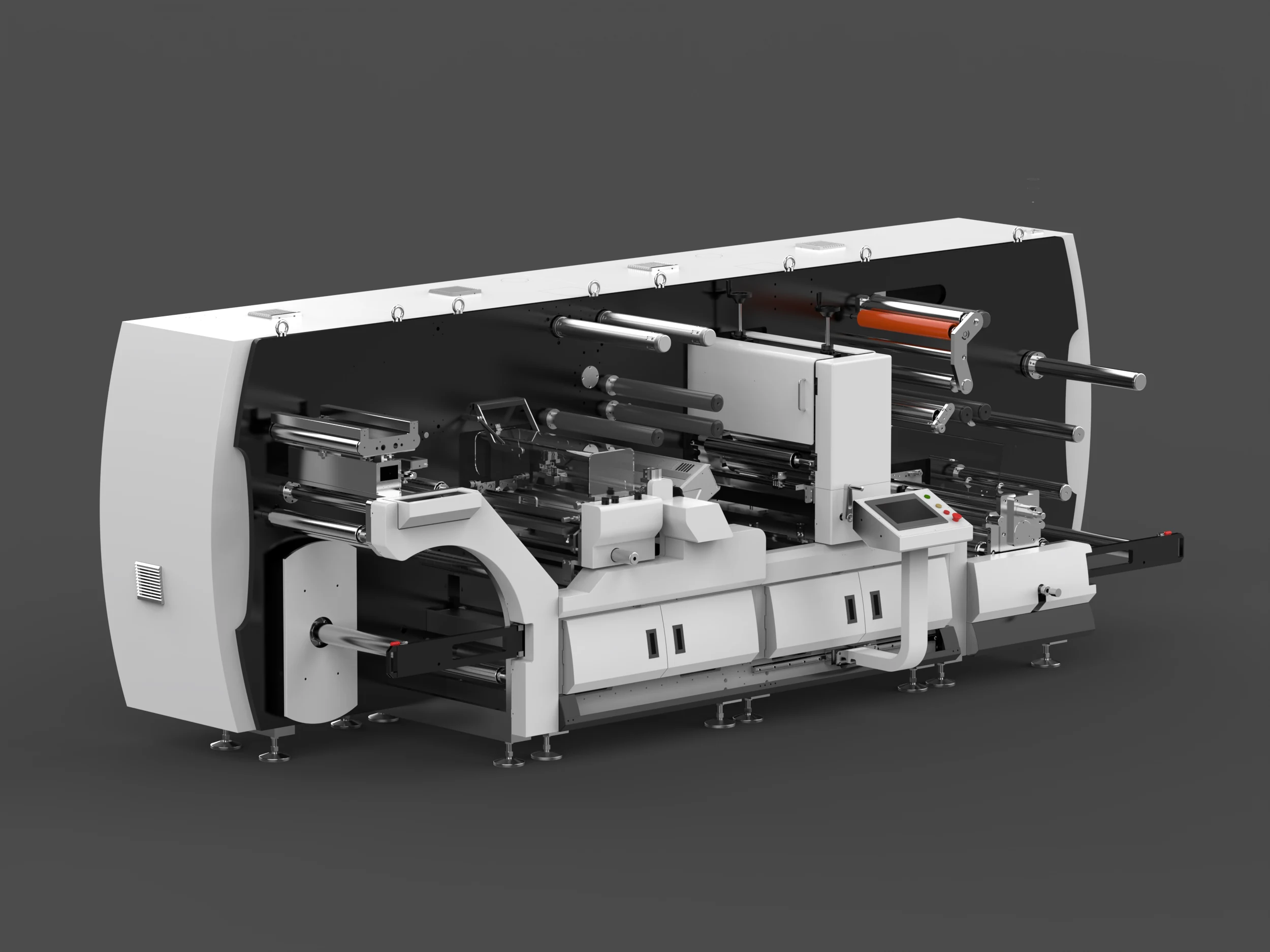
Two models from the same label finishing range: web unwind, rotary die-cutting station, waste matrix stripping and rewind, under a curved white housing. The models differ in their station layout, so each got its own render set, lit and framed identically so the range reads as one family.
- Equipment
- Rotary die-cutting and label finishing machines
- Sector
- Label printing and converting
- Built from
- CAD and reference photographs
- Delivered
- 5 stills at 2500 × 1875
- Models
- Model A: 3 views, Model B: 2 views
- Used for
- Catalogue, website, trade show
What we worked from.
Alongside the CAD, the manufacturer supplied workshop photographs of both machines. We used them to match colours, finishes and details, then replaced them with a clean, consistent render set.
Model A.
Three views of the first model: hero, high angle over the full web path, and the operator side with the touch panel. Select any image to view it at full size.
Model B.
The second model in the range, with a different station layout, rendered with the same lighting, floor and camera height so the two sit side by side in a catalogue.
What the visuals had to do.
- One range, one lookTwo models had to look like one product family, so buyers compare features rather than photography.
- Show the web pathUnwind, die station, waste stripping and rewind needed to read clearly from the hero angle.
- Better than the factory photosThe reference photographs were taken in a busy workshop. The renders give sales a clean, consistent alternative.
How we built it.
Each model was prepared from CAD, with hidden internals simplified and every visible part kept at engineered dimensions. The manufacturer's workshop photographs were used as a reference for colours, finishes and details such as the red roller caps and the touch panel.
Both models share one scene: a dark studio floor, the same key light and the same camera height. That is what makes a range look consistent, and it means further models can be added to the set at a fraction of the first cost.
Renders were delivered at 2500 × 1875 pixels, enough for brochure spreads and trade show panels.
Where these visuals work
- Product range catalogues
- Website model pages
- Trade show panels and screens
- Dealer and distributor sales kits
Services behind this project.
One prepared model feeds every service below, so each further asset costs less than the first.
What a project like this costs.
Fixed prices, CAD preparation included, full commercial usage rights on payment. Complex machines are scoped individually. Full pricing
Questions.
Can you render a whole machine range in one consistent style?
Yes. Once the first model is set up, every further model shares the lighting, floor and camera, so the range reads as one family. Range packages start at $7,900.
Can you work from photographs as well as CAD?
Yes. CAD gives us the geometry, and photographs of the real machine help us match colours, finishes and details exactly.
Can you animate the web path through a die-cutting machine?
Yes. A process film follows the web from unwind through die-cutting and waste stripping to rewind. Line films start at $7,900.